 English
  German
 Professional development
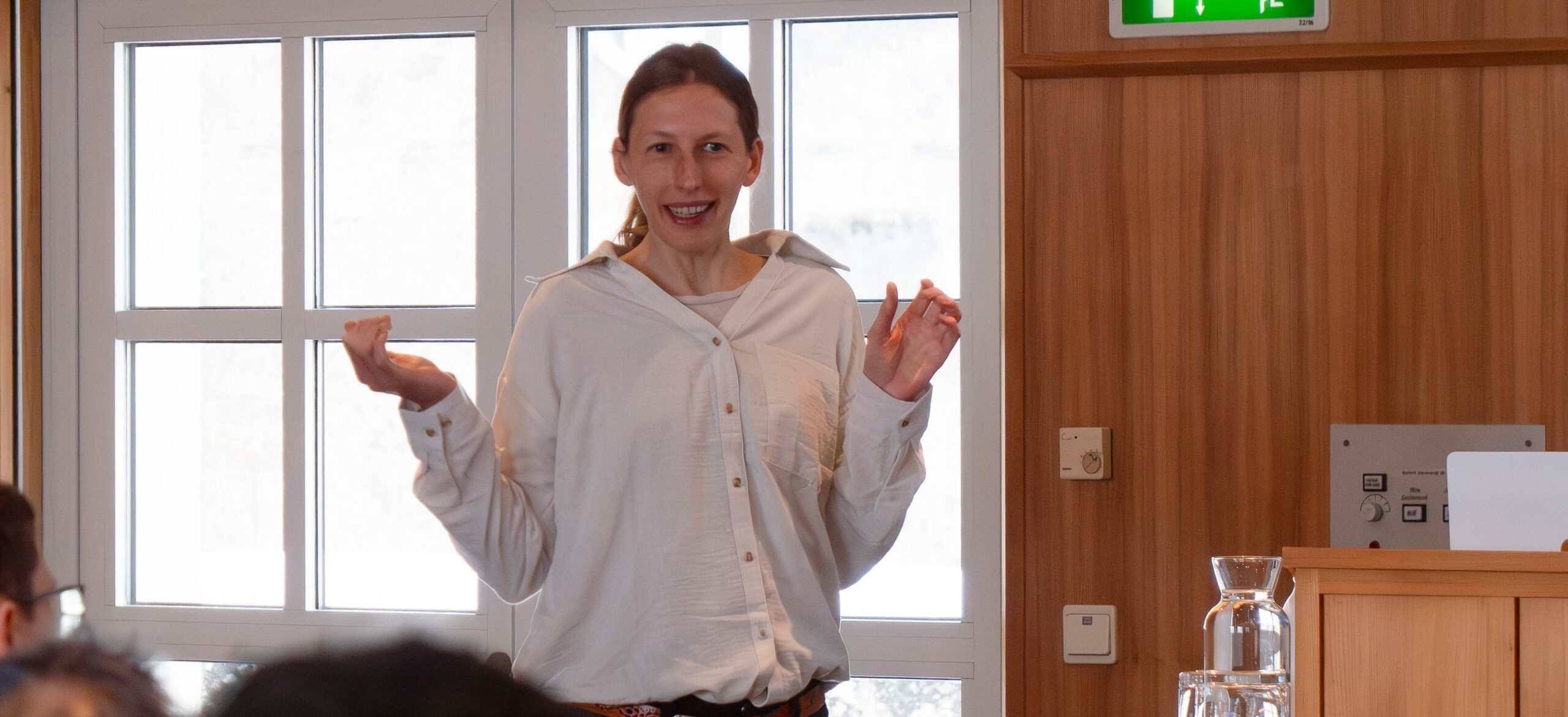
Becoming a successful researcher requires more than just expertise in your field and technical skills. Self-management, career planning, communication and leadership are equally important. Such transferable skills are rarely part of university or professional curricula. And yet excellent research and individual progression depend on them. My workshops provide a space to develop competencies and strategies in these domains. Approaching interpersonal and intrapersonal questions with curiosity can be both fun and effective.
Effective interpersonal communication, self-management and leadership
Science is a collaborative process. Whether you work in a small team or a large international project, you will have to work with other people and stakeholders, which can be enjoyable and at times uncomfortable. Working well with others is a source of real satisfaction and pays off in productivity, while unresolved conflict can make people miserable and unproductive. Designing meetings so that they move projects forward, giving feedback in a supportive way and handling challenging situations constructively can all be learned and are aspects of good leadership.
I have been part of many interdisciplinary academic teams, as a project leader with staff responsibility, as a co-supervisor of many students, and as chair of the communication committee of a large international academic society as well as of various interest groups, and I have seen what works and what does not.
Being a good team member and leader also requires being able to manage yourself: having a structure and a plan, and knowing what you want and where your values and boundaries lie, is what allows you to communicate them and to stay motivated and clear. Self-reflection is therefore an important part of my workshops.
Performance skills
An important part of career development in academia is being able to present your science in an understandable and engaging way, whether in conference presentations, job interviews, stakeholder engagement or teaching. Some people seem more talented at this than others, but these are skills that anyone can learn and improve with practice and through well-established principles for structure, storytelling, slide design and bodily awareness.
Dealing with stage fright and impostor thoughts belongs here too, since performance and personal development are highly connected. The aim is confidence that does not feel like pretending. I have been teaching and presenting in various settings, from statistics courses and conference talks to moderating improv theatre shows. In my trainings, I want to share the joy I have when continuously working on my own performance competence.
My approach
I combine my expertise on the academic system with my psychology background and applied improvisation, which provides fun and effective approaches from improv theatre used for professional purposes. Being comfortable on stage, aware of your body language and in control of your voice are important skills for scientific presentations.
Beyond that, improv theatre builds on a constructive mindset (the “Yes, and …” principle), on co-creation (combining what different people bring in order to build something none of them could have built alone) and on attention and listening, so that nothing important gets missed. Training these skills can substantially improve collaboration at work.
In my workshops I combine theory, for example from communication science or creativity research, with hands-on experimentation in a safe space and structured reflection.
Professional development workshop examples
Building bridges for Success: Effective Communication For Scientists
Effective communication is the key to building strong collaborations, profiting from everyone’s input in meetings, and fostering positive interactions with supervisors and students. In this workshop, a variety of communication strategies are introduced and discussed. Engaging exercises will allow you to practice and try out different forms of communication in a safe environment.
The aim of the workshop is to help you to
- deliver feedback constructively
- handle difficult conversations with confidence
- resolve work-place conflicts
- use active listening strategies to best benefit from your colleagues’ perspectives
- increase your impact by successfully conveying your own perspective through the principle of non-violent communication
- lead and moderate meetings effectively
This workshop is conceptualised for up to 12 participants, and either as a 1-day version (basic principles) and a 2-day version (additionally working on own examples). Amended versions include a half-day teaser workshop for up to 30 participants.
Creativity in Science
Scientific work depends not only on rigorous methods but also on creative thinking to develop new theories and solve practical problems. This workshop focuses on concrete strategies to activate creativity. This workshop introduces concrete strategies to support creative thinking in research. Short inputs will provide insights from creativity research, while practical exercises will help you activate flexible thinking, try out idea-generation techniques, and reflect on how to make creativity a productive part of your scientific work.
The aim of the workshop is to help you to
- understand the role of creativity in scientific thinking and problem-solving
- explore methods that support flexible thinking and idea generation
- apply creativity tools to real research questions
- reflect on how to integrate creative processes into your individual research practice
This is conceptualised as a half-day workshop, optimal for 15-25 people.
Making a scientific research presentation
Mastering the art of scientific presentations will help you to convey complex ideas to diverse audiences and, thus, leave a lasting impact.
This workshop introduces diverse strategies for preparing and delivering compelling presentations. Through the examination of specific examples, you will identify and discuss features that underpin effective scientific research presentations. Engaging exercises will allow you to apply different strategies to your own example and receive constructive feedback in a safe environment.
The workshop will help you to:
- identify main messages and key takeaways from complex ideas
- structure the content and develop narratives to enhance the memorability of your presentations
- create effective visualizations and design slides to maximize clarity and signal-to-noise ratio
- develop strategies for connecting and engaging with the audience
- approach scientific presentations with a positive mindset and with self-confidence
At the end of the workshop, you will not only leave with tangible outcomes but also with a toolkit of strategies ready to apply when preparing future presentations.
This workshop can be offered as a 1-day or extended 2-day version is best suited for a group not larger than 20 participants.
The Confidence Boost: Techniques from Theatre to Master Difficult Situations
Effective presentation skills and mastering situations with self-confidence are essential for making a lasting impact in various settings, including conferences, interviews, meetings, and discussions. This engaging and dynamic workshop draws upon techniques and strategies from the world of theatre to help participants understand the power of mindset, body language and their interaction. In a safe, supportive, and fun environment, participants experiment with their nonverbal and verbal communication, posture and voice, and receive constructive feedback.
Day one covers basic principles and introduces the theatre format, giving participants space to get comfortable with acting techniques. Day two focuses on using theatre techniques to try out strategies to master difficult situations. We will work on specific examples tailored to participants’ interests. The workshop’s goal is not to teach participants how to “act” as someone else, but rather to help them become more aware of their own communication habits and to experiment with new techniques. Introspection and respectful group reflection will help transferring these techniques to real-life situations.
This workshop is best suited for a group not larger than 10 participants and ideally given as a 2-day workshop.
My contributions to the field
Alongside my research, I have consistently taken on the roles to support communication within and outside my research community (also see my activities within the Open Science community here).
Selected activities:
- Blog team lead and chair of the Communication Committee of the Organization for Human Brain Mapping (world’s largest body for neuroimaging), 2020-2022. The role involved leading an international team of neuroscientists creating blog posts and a podcast and liaising with OHBM Council and other committees and special-interest groups.
- Working group “Error culture” in science of the NFDI EduTrain consortium (2024 onwards).
- Mentor in the mentoring programme of the Organization for Human Brain Mapping: mentored PhD students at several institutions who completed their doctorates and moved into postdoctoral positions.